
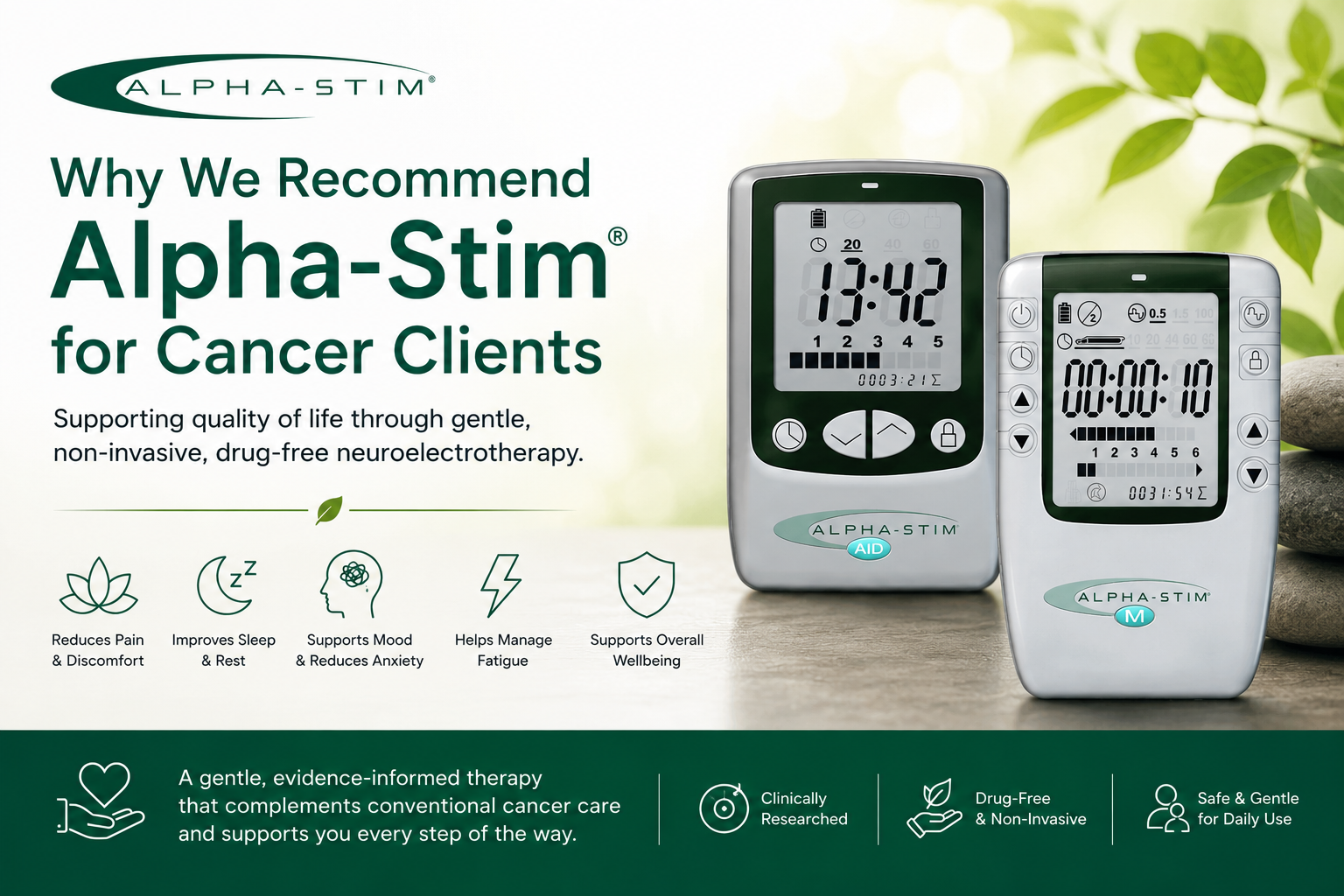
And no — it's not because it treats cancer. It doesn't. But cancer is never just a tumour, and that's exactly where Alpha-Stim earns its place.
⏱ In a hurry? Click here for the 60-second summary+−
Alpha-Stim does not treat or cure cancer — and we'll never claim it does. We recommend it to our cancer clients for what surrounds the diagnosis: most arrive with a nervous system that's been stuck in fight-or-flight for years, often after prolonged stress or trauma, and a body in that state struggles to rest, digest, sleep, and repair. Then the diagnosis itself brings shock, anxiety, sleepless 3am nights, and a crushing sense of helplessness. Alpha-Stim is a regulated, drug-free medical device clinically used for anxiety, insomnia, depression, and pain — twenty minutes a day at home helps calm the racing mind, restore sleep, ease pain without adding another pill, and hand back a sense of control. It doesn't fight the cancer; it looks after the person who has it, so the rest of their treatment lands in a body that's ready to recover. A preliminary study at MD Anderson Cancer Center found CES safe for advanced cancer patients, with significant improvements in anxiety, depression, pain and sleep — and reduced medication use. Read on for the full story — or come and talk to us at Ferrymead or Gleniti.
Let's get the most important thing out of the way first, because we'd rather be blunt than misunderstood: Alpha-Stim does not treat, cure, or prevent cancer. Nobody should ever tell you it does, and if they do, walk away.
So why does almost every cancer client who walks through our doors at Brilin — Ferrymead or Gleniti — end up hearing about Alpha-Stim from us?
Because cancer is never just a tumour. It's a diagnosis that lands on a whole person — a person with a nervous system, a sleep pattern, a history, a family, and a 3am mind that won't switch off. And that's exactly the territory where Alpha-Stim earns its place. Here's the full picture.
1. The story that usually comes before the diagnosis
When we sit down with cancer clients and take a proper history — not the ten-minute version, the real one — a pattern shows up so often it's almost eerie.
Somewhere in the years before the diagnosis, there was a long stretch of relentless stress. A brutal divorce. The death of someone irreplaceable. Years of caring for a sick parent. A business collapse. Old trauma that was never dealt with, just boxed up and stored somewhere out of conscious reach.
We're careful here: science hasn't proven that stress causes cancer, and we won't claim it does. But what research does show is that chronic stress keeps the body locked in sympathetic dominance — the fight-or-flight state — and that this state changes how the whole system operates. Stress hormones stay elevated. Sleep degrades. Immune function shifts. Digestion gets deprioritised, because a body convinced it's running from danger doesn't waste resources breaking down lunch. Repair, restoration, and housekeeping all get pushed down the queue.
Fight-or-flight is brilliant for surviving five minutes of danger. It was never designed to run for five years.
Here's the part most people miss: the conscious mind moves on, but the nervous system keeps score. You can stop thinking about a painful chapter of your life — genuinely stop, not just pretend — and the imprint remains underneath. Then something vaguely similar happens years later, and the body replays the old emotional response before your thinking brain even gets a vote. Suppressing a memory is not the same as resolving it. The stress physiology, the tension patterns, what many healing traditions would describe as blocked energy in the body — all of it can still be quietly running in the background.
So when a cancer client arrives, we're often looking at a nervous system that has been dysregulated for a very long time. Whatever role that played or didn't play in the past, one thing is certain about the present: a body stuck in fight-or-flight is a terrible environment for healing and recovery. Rest, repair, digestion, immune activity, sleep — everything the body needs right now lives on the parasympathetic side of the nervous system.
Alpha-Stim's job, in plain terms, is to help the nervous system come down off high alert. Cranial electrotherapy stimulation (CES) delivers a tiny, precisely tuned microcurrent — via clips on the earlobes — that nudges brain activity toward the calmer alpha state. Twenty to sixty minutes a day, reading a book or watching telly. Clients typically describe feeling calm but clear-headed, not drugged or foggy.
For someone whose body has forgotten what "safe" feels like, that daily shift out of fight-or-flight is not a small thing. It's foundational.
2. The bomb that goes off at diagnosis
The second angle is the diagnosis itself.
Nobody pencils in cancer. It arrives sideways — a routine scan, a lump that "was probably nothing," a GP's voice changing tone on the phone. And in one sentence, the ground disappears.
What follows is a wave of fear and anxiety that most people have never experienced at that intensity. The mind goes into overdrive: What happens to my kids? Did I cause this? What did that look on the specialist's face mean? What if the treatment doesn't work? Round and round, fastest of all at 2am, when the house is silent and there's nothing to interrupt the loop.
Sleep — the one thing the body desperately needs heading into treatment — is usually the first casualty. And poor sleep feeds the anxiety, which wrecks the next night's sleep, which deepens the low mood and the creeping sense of helplessness about the future. It's a vicious spiral, and it starts at precisely the worst moment.
This is Alpha-Stim's home ground. CES is a recognised, regulated medical technology used for anxiety, insomnia, and depression — backed by decades of clinical research. It doesn't sedate you or knock you out. It helps quiet the electrical over-activity behind the racing mind, so that when your head hits the pillow, the mind actually has a chance to follow the body into rest.
Clients tell us the same things again and again: the 3am wake-ups ease off. The mental noise drops a few notches. The dread is still real — no device makes a cancer diagnosis okay — but it stops running the whole show. And a person who has slept is a different person in the oncologist's office: clearer, steadier, better able to take in information and make good decisions.
3. Pain relief without another pill
The third angle is pain.
Pain is part of the cancer journey for many people — from the disease itself, from surgery, from treatment side effects. And the standard toolkit leans heavily on medication, which brings its own baggage: grogginess, constipation, brain fog, dependence risk, and interactions with an already-crowded medication list.
The Alpha-Stim M includes microcurrent electrical therapy (MET) for pain, applied with smart probes or electrode pads directly where it hurts. It's drug-free, non-addictive, and without the side-effect profile of pain medication. For someone already managing a shelf full of prescriptions, having a pain tool that adds nothing to that chemical load — and can be used as often as needed — matters enormously.
To be clear: we never tell anyone to ditch their prescribed pain relief. That's a conversation for their medical team. But having a safe, drug-free option in the toolkit — one they control themselves — often changes the whole relationship with pain.
4. The treatment marathon nobody warns you about
Diagnosis is the starting gun, not the race. Then come months of surgery, chemotherapy, radiation, immunotherapy — each round with its own build-up of dread. And then the scans. Anyone who's been through cancer knows "scanxiety": the sleepless week before every follow-up scan, waiting to find out whether life continues as planned.
A daily Alpha-Stim session gives the nervous system a reliable reset button through all of it. Not a one-off fix — a practice. Twenty minutes a day where the body gets permission to stand down.
5. Rest-and-digest is where recovery happens
Remember what fight-or-flight switches off? Digestion and repair. Now consider what a body going through cancer treatment needs most: nutrition it can actually absorb, an immune system with resources to spare, and deep sleep — the shift when the body does its most serious repair and maintenance work.
All of that lives in the parasympathetic state. Helping a client spend more of each day in rest-and-digest doesn't treat their cancer — but it means the good food, the supplements, the rest, and the medical treatment are all landing in a body that's positioned to use them. Appetite often improves. Digestion settles. Energy stops leaking into a threat response that serves no purpose in a hospital waiting room.
6. Handing back the steering wheel
There's a psychological angle that might matter as much as any of the physiology.
Cancer strips people of control. Your schedule belongs to the hospital. Your body is doing things without your permission. Specialists talk over your head. Helplessness isn't just a feeling — it becomes the daily reality, and it corrodes people.
Alpha-Stim is something the client does for themselves, every day, at home, on their own terms. It's a small act of agency — I am actively looking after my nervous system today — repeated daily. Over months of treatment, that shift from passenger to participant is worth a great deal. Ask anyone who's been through it.
7. And the person sitting beside them
One more angle, because we see it constantly: the partner, the daughter, the husband in the waiting room is often barely holding together themselves. Caregivers run on the same broken sleep and background dread — they just don't feel entitled to complain about it. The same device that helps our client sleep can help the person carrying them. Households share an Alpha-Stim more often than you'd think.
It doesn't fight the cancer. It looks after the person who has it — so the rest of their treatment lands in a body that's ready to recover.
Don't just take our word for it — what the research shows
Everything above comes from what we see in clinic. But Alpha-Stim's use with cancer patients has also been studied clinically — including at one of the most respected cancer hospitals in the world.
The MD Anderson study
In a preliminary clinical study conducted at MD Anderson Cancer Center in Texas, researchers gave patients with advanced cancer a four-week course of cranial electrotherapy stimulation — the same CES technology in the Alpha-Stim — and measured what happened to their depression, anxiety, sleep, and pain (Yennurajalingam et al., 2018, Journal of Pain and Symptom Management).1
The results speak for themselves. Of 36 patients, 33 completed the full programme. Adherence was 93% — remarkable for seriously ill patients — and satisfaction scores were a median 10 out of 10. There were no serious adverse events. After four weeks, patients showed statistically significant improvements in anxiety, depression, pain, and sleep-related daytime function.
And one finding we find especially telling: medication use went down. Patients relying on a device that calms the nervous system found they needed fewer drugs — exactly the outcome we described in the pain section above. The researchers concluded that CES was safe and feasible for advanced cancer patients and that the results justified larger studies.
The head and neck cancer pain report
Decades earlier, Dr William Bauer published clinical cases in the Archives of Otolaryngology (1983) describing patients with severe head and neck cancer pain that had not responded to heavy pain medication or surgery.2 Treated with Alpha-Stim microcurrent technology at Case Western Reserve University School of Medicine and the Cleveland VA Medical Center, every patient experienced reduced pain — with relief lasting at least eight hours per session, and in one case more than three weeks — with no side effects reported.
We'll be straight with you about the limits: the MD Anderson study was preliminary and had no control group, and Bauer's report covered a small number of cases. This is early-stage evidence, not final proof — the researchers themselves call for larger trials. But notice what was being measured in both: anxiety, depression, sleep, pain, quality of life. Not tumour response. The research asks exactly the same question we do — can this technology help the person carrying the cancer feel and function better? — and so far, the answer points firmly to yes.
What Alpha-Stim is — and what it isn't
It is: a regulated cranial electrotherapy stimulation medical device with a long clinical research history (see alpha-stim.co.nz), used for anxiety, insomnia, depression and (Alpha-Stim M) pain. Drug-free, non-invasive, non-addictive, safe to use daily, and usable at home (available to rent via alphastimhire.co.nz or our hire page).
It is not: a cancer treatment. It does not shrink tumours, kill cancer cells, or replace surgery, chemotherapy, radiation, or any care your oncology team recommends. Anything you do alongside conventional treatment — including Alpha-Stim — should be mentioned to your medical team, and people with implanted electronic devices such as pacemakers should not use it.
What it can do is protect the ground the rest of your care stands on: your sleep, your calm, your comfort, your resilience. In our experience, that's the difference between a client who is merely surviving treatment and one who has the reserves to genuinely recover and live well through it — and after it.
That's why we recommend it. Not as a weapon against cancer, but as an ally for the human being who has it.
Supporting you through your cancer journey
If you or someone you love is walking this road, come and talk to us at Ferrymead (Christchurch) or Gleniti (Timaru). We'll show you the Alpha-Stim, answer your questions honestly, and help you decide whether it belongs in your support toolkit.
Book a ConsultationReferences
- Yennurajalingam S, Kang D-H, Hwu W-J, Padhye NS, Masino C, Dibaj SS, Liu DD, Williams JL, Lu Z, Bruera E. Cranial electrotherapy stimulation for the management of depression, anxiety, sleep disturbance, and pain in patients with advanced cancer: a preliminary study. Journal of Pain and Symptom Management. 2018;55(2):198–206. Study conducted at MD Anderson Cancer Center. View study summary
- Bauer W. Electrical treatment of severe head and neck cancer pain. Archives of Otolaryngology. 1983;109(6):382–383. View study summary