
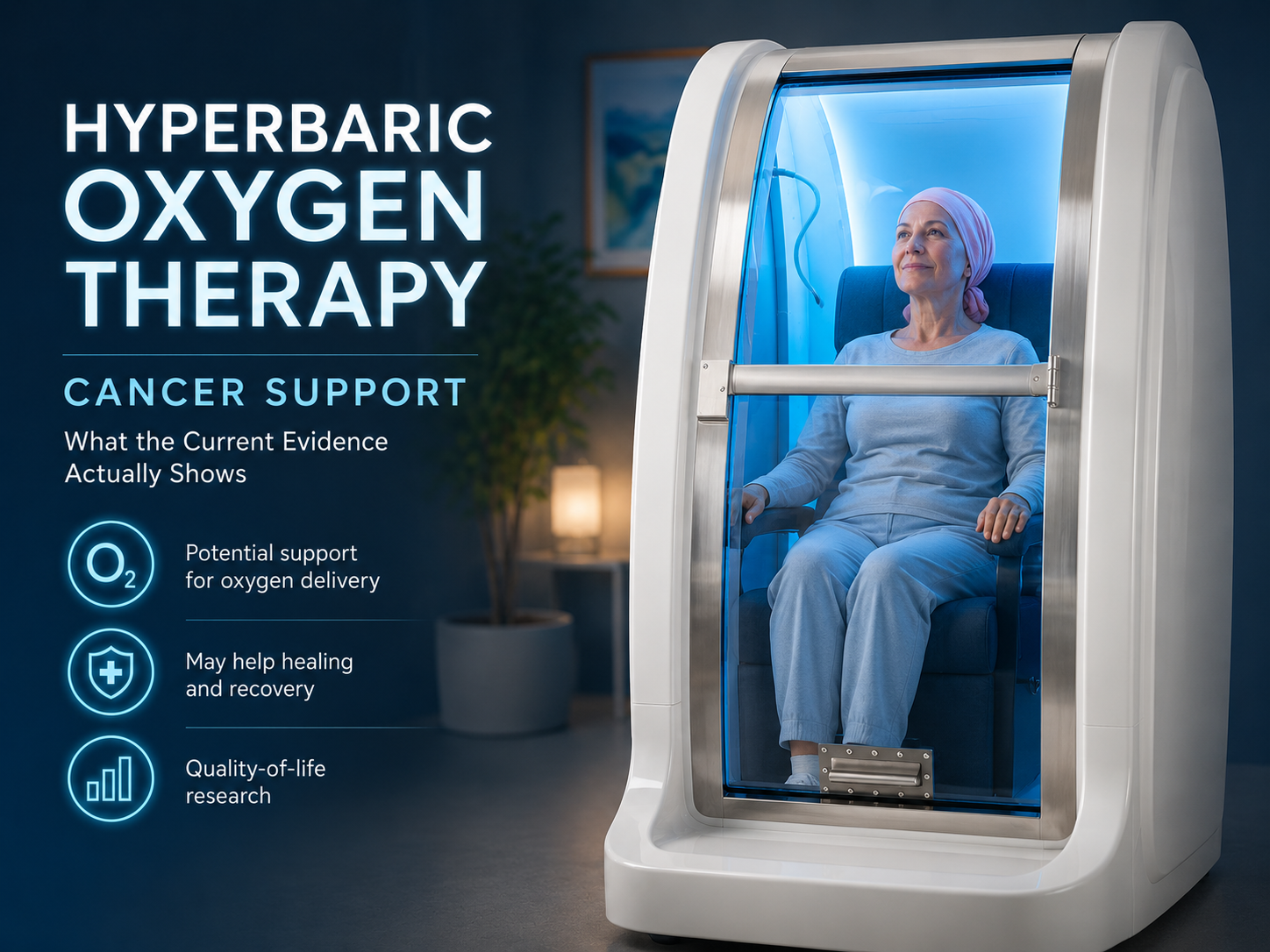
For anyone navigating a cancer diagnosis, the search for ways to feel stronger, recover better, and manage the toll of treatment is completely understandable. Hyperbaric oxygen therapy (HBOT) is one of the complementary approaches that comes up often in that search. It's a genuinely interesting area of research — but it's also one where the marketing frequently runs ahead of the science.
This article lays out what the clinical evidence currently supports, where it's still uncertain, and — just as importantly — where caution is essential. Our goal is to give you an honest, evidence-informed picture so you can have a well-grounded conversation with your oncology team.
⏱ Short on time? Read the 60-second summary+−
Hyperbaric oxygen therapy (HBOT) is not a treatment for cancer, and it isn't part of standard cancer care. The idea of oxygenating tumours to make radiation work better was genuinely tested in patients decades ago: it improved local tumour control in some trials but produced no survival benefit, and was largely abandoned. What the research does support is narrower but still meaningful. Reviews consistently find HBOT does not appear to promote tumour growth or recurrence — because tumours and healing wounds grow new blood vessels by different mechanisms — and a history of cancer is not considered a barrier to treatment. Its best-supported use is helping heal late radiation tissue injury, the delayed damage radiotherapy can cause to healthy tissue, though that evidence is limited and researchers genuinely disagree about it. Some people also value it as complementary support for wellbeing during a demanding treatment course. Safety matters and is specific: bleomycin and doxorubicin are absolute contraindications, so proper screening and coordination with your oncology team are essential. Molecular hydrogen and high-dose IV vitamin C combined with HBOT remain early-stage or untested in humans. The bottom line: treat HBOT as complementary supportive care alongside conventional oncology treatment, never as a replacement, and talk to your oncologist before starting.
What hyperbaric oxygen therapy is
HBOT involves breathing oxygen while inside a pressurised chamber. Because the body is under increased atmospheric pressure, far more oxygen dissolves directly into the blood plasma than is possible by breathing normally. That oxygen-rich plasma can reach tissues where circulation is compromised, which is why HBOT has a long, established track record in wound healing, decompression sickness, and certain infections.
The theory that draws attention in oncology is straightforward: many solid tumours contain regions of low oxygen (hypoxia), and hypoxic tissue tends to respond poorly to radiation and some chemotherapies. On paper, improving oxygen delivery sounds like it might help treatment work better. As we'll see, the reality is more nuanced than the theory.
The tumour-oxygenation question — handled honestly
It's worth being direct here, because this is where a lot of online content overreaches.
Tumour hypoxia is a real hallmark of many cancers, and low-oxygen environments are associated with more aggressive, treatment-resistant disease. That has led researchers to ask two very different questions — and, importantly, both have already been investigated in actual patients.
Question 1: Could adding oxygen make tumours more responsive to radiation?
This isn't a new idea, and it isn't merely theoretical. Back in the 1960s and 70s it was tested extensively: patients were irradiated while inside hyperbaric chambers, breathing oxygen under pressure, in the hope that better-oxygenated tumours would be more vulnerable to radiation. This approach was known as radiosensitisation, and it was the subject of numerous clinical trials, many of them randomised and controlled [6].
So what happened? Several of those studies did show improvements in local tumour control — but not in survival. Partly for that reason, and partly because delivering radiotherapy inside a hyperbaric chamber is cumbersome, the practice was largely abandoned [6]. Interest has never entirely disappeared: since the mid-1990s, Japanese research groups have explored delivering radiotherapy immediately after HBOT for high-grade brain tumours, and the approach remains a subject of ongoing research [6]. A dedicated Cochrane review exists on hyperbaric oxygenation for tumour sensitisation to radiotherapy.
The honest reading is that the oxygenation idea is scientifically credible and was given a serious clinical trial decades ago — but it did not deliver the survival benefit that would have established it, and it is not part of standard cancer care today. It is certainly not what happens in a routine HBOT session at a clinic, which is not synchronised with radiotherapy at all.
Question 2: Could adding oxygen instead feed tumour growth?
This is the concern patients most often raise, and it deserves a proper answer rather than a brush-off. The worry is intuitive: HBOT is used precisely because it stimulates angiogenesis (new blood vessel formation) and cell proliferation in healing wounds. Wouldn't it do the same for a tumour?
The reassuring answer, and the reason it's reassuring, is this: angiogenesis and cell proliferation are initiated and controlled through different mechanisms in tumours than in healing wounds [6]. That difference is why HBOT can enhance wound healing without correspondingly enhancing cancer growth — it isn't simply "fertiliser for cells."
The evidence supports this. Reviews of the accumulated cell culture, animal and clinical data — much of the clinical data coming from those very radiosensitisation trials, where cancer patients received substantial hyperbaric oxygen exposure — found that most studies showed no enhancement of cancer growth or recurrence, and a few even suggested possible retardation of malignant growth [1][6]. Studies in transplanted prostate cancer, chemically induced mammary tumours, head and neck xenografts and colorectal liver metastases models have not shown enhanced tumour growth; one reported inhibited growth of a transplanted human mammary tumour [6]. A more recent retrospective safety analysis reached the same conclusion [2]. Accordingly, standard hyperbaric medicine texts state that a history of malignancy should not be considered a contraindication to HBOT [6].
Where that leaves us
"Not harmful" is very different from "proven to help fight cancer." Some laboratory and animal studies suggest HBOT may have tumour-inhibitory effects in certain cancer subtypes [1], but these remain preclinical. There is no robust clinical evidence that HBOT as delivered in a clinic setting enhances the effectiveness of chemotherapy or radiation in patients.
In plain terms: HBOT should not be thought of as a treatment for cancer itself. Where the evidence is genuinely encouraging is somewhere quite different — in helping the body recover from the damage caused by cancer treatment.
Where the evidence is strongest: recovering from radiation injury
The best-supported use of HBOT in cancer care is managing late radiation tissue injury (LRTI) — the delayed damage that radiotherapy can cause to healthy tissue months or years after treatment ends.
A Cochrane systematic review — one of the most rigorous forms of evidence synthesis available — found that for people with radiation injury affecting the head, neck, bladder, and rectum, HBOT may be associated with improved healing, with low-to-moderate certainty evidence [3]. It may also reduce the risk of wounds breaking down after surgery and produce a modest reduction in pain following head and neck irradiation [3]. The reviewers were careful to note that HBOT is unlikely to affect the risk of death, and that the underlying trials are relatively small [3].
This picture is echoed elsewhere. A systematic review focused on breast cancer patients concluded HBOT might help reduce symptoms of late radiation toxicity such as pain and fibrosis, while emphasising that the evidence is limited and larger trials are needed [4]. A 2026 clinically focused review in a leading oncology journal likewise noted that only a small fraction of the published work reaches high-level evidence, and that treatment protocols still vary widely and need standardising [5].
Smaller studies have looked at radiation-related lymphedema after breast cancer treatment with modestly encouraging results — a British trial reported statistically significant reductions in arm volume sustained at 12 months, and a US study found an average 38% reduction in hand lymphedema, persisting for over a year in those who responded [6]. These were small, single-arm studies, so they indicate a signal worth investigating rather than proof.
It's only fair to note the dissenting evidence too. This is not a settled question, and the field contains genuine disagreement. A 2002 systematic review found that 67 of 74 published reports described successful treatment with HBOT [6] — but that literature was dominated by case series rather than controlled trials. Meanwhile, randomised controlled trials by Pritchard and colleagues (radiation-induced brachial plexopathy) and Annane and colleagues (osteoradionecrosis of the jaw) returned negative results, leading reviewers Delanian and Lefaix to conclude in 2007 that HBOT did not appear to be an effective treatment for radiation-induced fibrosis [6]. Those negative trials have themselves been contested on methodological grounds.
So the honest summary is: promising and increasingly used for radiation-related tissue damage, but still an evolving evidence base rather than a settled one — with credible researchers on both sides.
Supporting wellbeing and recovery alongside treatment
Beyond radiation injury, many people are drawn to HBOT — and to complementary therapies generally — for help with the broader burden of treatment: fatigue, disrupted sleep, low mood, pain, and the sheer physical depletion of a long treatment course.
It's reasonable to explore supportive care that improves quality of life, and HBOT is one option some clinics offer in that context. What matters is keeping expectations calibrated to the evidence: supportive and quality-of-life benefits are plausible and valued by many patients, but they are not the same as an anti-cancer effect, and they should always sit alongside conventional oncology care rather than in place of it.
A critical safety point: HBOT and chemotherapy don't always mix
This is the part of the conversation that responsible clinics must not skip.
Standard hyperbaric medicine references list only a small number of absolute contraindications to HBOT — and two of them are chemotherapy drugs [6][12]:
- Bleomycin — used for some lymphomas, testicular cancers, and other tumours — can cause serious lung toxicity, and high-dose oxygen appears to act synergistically with it. Concomitant or recent bleomycin treatment is an absolute contraindication. Importantly, the safe interval afterwards has never been firmly established: hyperbaric texts suggest a year is probably sufficient and that only recent exposure is a true barrier [6], while other references cite three to four months [12], and some clinicians treat any history of bleomycin as disqualifying. Anyone with bleomycin in their history needs individual assessment including lung function — not a rule of thumb.
- Doxorubicin taken concomitantly is also an absolute contraindication, on the basis of increased mortality demonstrated in animals given both together. Worth knowing for balance: no toxic effects have actually been reported in clinical use, and a short interval of a few days after the last dose is generally advised [6][12].
A note on cisplatin, and why we're flagging it. Cisplatin is often listed online as an HBOT contraindication, on the grounds that it may delay fibroblast proliferation and collagen deposition. But the standard hyperbaric medicine texts are more measured: they note the published evidence of clinically important effects is weak and conclude cisplatin should not be treated as a contraindication [6], while other references still counsel caution [12]. Sources genuinely disagree here. It's a matter for your medical team to weigh, not something to settle from a website — including this one.
The takeaway is simple but important: HBOT is not automatically safe to combine with active cancer treatment. Anyone considering it must disclose their full treatment history and medications, and any reputable provider should screen carefully and coordinate with the treating oncology team before proceeding.
Molecular hydrogen: an emerging, early-stage area
Molecular hydrogen therapy sometimes appears alongside HBOT in supportive-care settings. Hydrogen acts as a selective antioxidant, and preclinical work suggests anti-inflammatory and antioxidant properties [7].
The clinical picture is early and modest. Only a handful of cancer trials have been conducted since 2011, several of them small, observational, or from a limited number of research groups, and results are mixed — some report improvements in quality of life or reduced treatment side effects, while others show no significant difference [7][8]. Hydrogen does appear to have a favourable safety and low-toxicity profile [7], which is part of its appeal as a complementary option, but the evidence base is nowhere near established, and it should be understood as investigational rather than proven.
"What about combining HBOT with high-dose IV vitamin C?"
This question comes up often, because many people receiving intravenous vitamin C (IVC) alongside their cancer care also ask about hyperbaric oxygen. It deserves a direct answer.
The theory. At the blood concentrations achievable only by intravenous infusion — not by oral doses — vitamin C stops behaving like a conventional antioxidant and acts as a pro-oxidant, generating hydrogen peroxide in the space around cells [9]. Because HBOT raises tissue oxygen levels, the reasoning is that the two together might amplify oxidative stress within tumour cells more than either alone.
The evidence. This has been tested — but, as far as the published literature shows, essentially only in cell cultures. A research group at the University of South Florida reported that vitamin C produced anti-cancer effects in vitro via an oxidative-stress mechanism, and that HBOT appeared to enhance that effect [9]. That's a legitimately interesting finding. It's also important to be precise about what it is: laboratory work on cells, reported largely through conference abstracts rather than full peer-reviewed trials. We are not aware of any published human clinical trial testing HBOT combined with high-dose IV vitamin C in cancer patients. Claims that the two are a proven or synergistic pairing are running well ahead of the evidence.
High-dose IVC on its own has been studied more substantially. Phase I–II trials have found it generally safe and reasonably well tolerated alongside chemotherapy, though in small numbers of patients with advanced disease [10]. Reviews report encouraging clinical evidence that it can reduce chemotherapy-related side effects such as fatigue and improve quality of life, particularly in palliative care — while stating plainly that its anticancer efficacy remains unproven and needs far larger trials [11].
So the honest position is this: IVC has a modest supportive-care evidence base of its own; the combination with HBOT is a mechanistic hypothesis with cell-culture support, not an established protocol.
Two cautions worth knowing. IVC is not risk-free. It requires screening — including for G6PD deficiency, where high-dose vitamin C can trigger dangerous red blood cell breakdown — and careful attention to kidney function, since infusions raise oxalate levels [10]. It should be medically supervised and coordinated with your oncology team, not stacked on informally.
And an open question we'd rather raise than gloss over: the IVC rationale depends on increasing oxidative stress, while molecular hydrogen works by reducing certain reactive oxygen species. Hydrogen appears to be selective — targeting hydroxyl radicals and peroxynitrite rather than hydrogen peroxide directly [7] — so the two may not simply cancel each other out. But how these therapies interact when combined has not been properly studied in people, and anyone expressing confidence either way is going beyond what's known.
A real-world example: Brilin's H+HBOT HydroxyPod
At Brilin, we offer a dedicated support option — our exclusive H⁺HBOT HydroxyPod, which combines hyperbaric oxygen with molecular hydrogen therapy — for clients who want structured complementary support during and after their cancer treatment journey.
We're deliberately clear about what this is and isn't. It is complementary supportive care, aimed at wellbeing, comfort, and recovery, designed to work alongside the treatment your oncology team provides — never as a substitute for it, and not as a treatment for cancer itself. Before anyone begins, we take a full treatment and medication history and, where appropriate, coordinate with your medical team, precisely because of the safety considerations outlined above. If HBOT isn't appropriate or safe for your situation, we'll tell you.
If you'd like to understand whether this kind of support might suit where you are in your journey, we're happy to talk it through honestly.
The bottom line
- HBOT is not a treatment for cancer. Using oxygen to sensitise tumours to radiation was trialled extensively decades ago — it improved local control but not survival, and was largely abandoned.
- Reviews suggest HBOT does not promote tumour growth or recurrence, because tumour and wound blood-vessel growth are driven by different mechanisms. A history of malignancy is not a contraindication.
- Its best-supported oncology use is helping heal late radiation tissue injury — though the evidence is limited, and credible researchers disagree, with several negative randomised trials alongside many positive case series.
- It may support quality of life during a demanding treatment course, as complementary care.
- Safety is real and specific: bleomycin and doxorubicin are absolute contraindications, and the safe interval after bleomycin is genuinely unsettled. Careful screening and oncology coordination are essential.
- Molecular hydrogen is a promising but early-stage area.
- HBOT combined with high-dose IV vitamin C has cell-culture support only — no published human trials. IVC itself has some supportive-care evidence but requires medical screening and oncology coordination.
If you're weighing up complementary options, the single most valuable step is an open conversation with your oncology team, combined with a provider who is honest about both the possibilities and the limits.
Discuss your complementary care options
If you're interested in structured, complementary support during or after your treatment, we're here to help you understand what might be appropriate for your situation.
Book a ConsultationReferences
- Moen I, Stuhr LEB. Hyperbaric oxygen therapy and cancer—a review. Targeted Oncology. 2012;7(4):233–242.
- Hyperbaric Oxygen Therapy for Managing Cancer Treatment Complications: A Safety Evaluation. Medicina/PMC. 2025.
- Lin ZC, Bennett MH, Hawkins GC, et al. Hyperbaric oxygen therapy for late radiation tissue injury. Cochrane Database of Systematic Reviews. 2023, Issue 8. Art. No.: CD005005.
- Meier EL, Mink van der Molen DR, Lansdorp CA, et al. Hyperbaric oxygen therapy for local late radiation toxicity in breast cancer patients: a systematic review. The Breast. 2022.
- Dejonckheere C, et al. Hyperbaric oxygen therapy for chronic radiotherapy-related adverse effects: a clinically focused review. CA: A Cancer Journal for Clinicians. 2026.
- Neuman TS, Thom SR (eds). Physiology and Medicine of Hyperbaric Oxygen Therapy. Saunders/Elsevier, 2008.
- Molecular Hydrogen Therapy — A Review on Clinical Studies and Outcomes. 2023.
- A Systematic Review of Molecular Hydrogen Therapy in Cancer Management. 2023.
- DeBlasi JM, et al. Anti-cancer effects of ascorbic acid and hyperbaric oxygen therapy in vitro. The FASEB Journal. 2017;31(1_supplement):879.4.
- Hoffer LJ, Robitaille L, Zakarian R, et al. High-dose intravenous vitamin C combined with cytotoxic chemotherapy in patients with advanced cancer: a phase I-II clinical trial. PLoS ONE. 2015;10(4):e0120228.
- High-dose intravenous vitamin C, a promising multi-targeting agent in the treatment of cancer. Journal of Experimental & Clinical Cancer Research. 2021.
- Hyperbaric Contraindicated Chemotherapeutic Agents. StatPearls [NCBI Bookshelf].