
How Resonance Is Used in Rife Technology
What Is Frequency?
Frequency describes the number of cycles that occur each second in a repeating vibration or oscillation. The unit commonly used to describe frequency is the hertz, or Hz.
Frequency became central to Rife's work because of his focus on the relationship between microorganisms and particular frequencies.
The concept becomes easier to understand through the principle of resonance.
The Principle of Resonance
Resonance occurs when an object or system responds strongly to a particular frequency that corresponds with its own natural oscillatory characteristics.
A familiar example is a bridge. Every structure has natural patterns of vibration. When an external force repeatedly acts at a frequency that corresponds with one of those patterns, the resulting vibration can become increasingly pronounced.
This provides a useful way of visualising resonance. The important factor is the relationship between the frequency being introduced and the natural frequency of the object or system.
The same principle forms the foundation of the frequency approach associated with Royal Raymond Rife.
Rife and the Observation of Microorganisms
Rife's work with microscopy played an important role in the development of his ideas about microorganisms and frequency.
At the time, existing microscopes had limitations in their ability to observe individual microorganisms. Rife worked to develop increasingly sophisticated optical instruments that would allow him to examine microorganisms while they remained alive.
His Universal Microscope was completed in 1933 and is described as having approximately 60,000 times magnification, with a resolution of 31,000.
Being able to observe microorganisms in their living state was important because Rife wanted to study their characteristics, behaviour and responses rather than examining specimens only after they had been altered or destroyed.
This work became closely connected with his interest in identifying characteristics associated with individual microorganisms and exploring their relationship with frequency.
Microorganisms and Resonant Frequency
Within the Rife model, different microorganisms are associated with particular resonant frequencies, sometimes described as an intrinsic radiation signature.
The basic concept is that an externally generated frequency corresponding to a particular target's resonant characteristics could interact with that target through resonance.
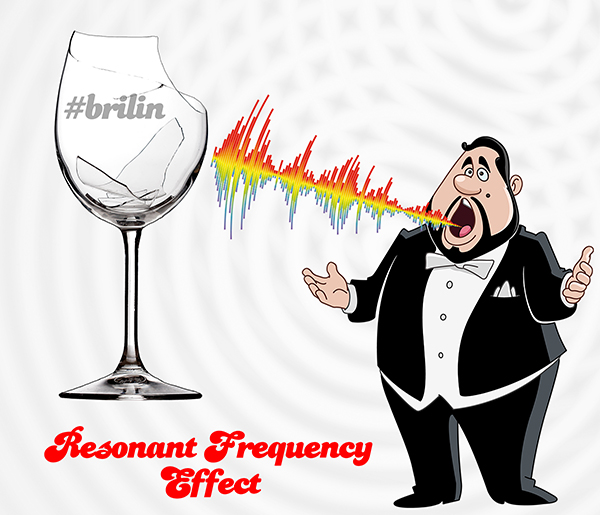
One of the simplest ways to visualise this idea is through the example of a singer producing a focused tone that causes a glass to vibrate.
The important point in the analogy is not simply that sound is being produced. It is that a particular frequency can produce a much stronger response when it corresponds to the natural characteristics of the object.
Applied to Rife's theory, the frequency is intended to interact with the target through resonance rather than through the introduction of a chemical substance.
From Resonance to the Rife Ray
Rife's interest in resonance developed alongside his microscopy work and his observations of microorganisms.
Rife experimented with a number of ray machine designs before developing equipment that satisfied him.
His earliest Rife Ray, identified as the Rife Ray No. 1, was built in 1921, before completion of the Universal Microscope. A second Rife Ray was built in 1923.
The equipment was developed around the idea that different microorganisms could be associated with different frequencies and that those frequencies could be generated and directed toward the biological target.
This relationship between observation, frequency identification and frequency generation became a central feature of the technology associated with Rife. You can read more about the GB4000 Rife machine we offer, or explore our Rife sessions.
Why the Particular Frequency Matters
Resonance is therefore more than simply the use of electrical or electromagnetic energy.
The underlying concept depends on the specific frequency.
Different frequencies are associated with different biological targets within the Rife model. This is why the historical development of Rife technology involved considerable attention to identifying and selecting particular frequencies rather than treating frequency as one universal setting.
The concept can be summarised simply:
- Everything has an oscillatory or vibrational characteristic.
- Different microorganisms are described as having their own characteristic resonant frequencies.
- A frequency corresponding with a target's resonant characteristics may produce an interaction with that target.
- Rife technology was developed around the idea of using frequency in this manner.
Understanding Resonance Through the Bridge Analogy
The bridge analogy provides another straightforward way to understand the concept.
A bridge has natural patterns of vibration. If an external force repeatedly corresponds with one of those patterns, the structure can respond more strongly.
In the same conceptual framework, a microorganism is described as having characteristic resonant properties. A frequency corresponding with those properties is intended to produce a specific interaction.
The analogy helps illustrate why frequency selection became such an important part of Rife technology.
The concept is not simply about producing a frequency. It is about the relationship between the frequency and the particular target.
The Foundation of Rife Technology
Royal Raymond Rife's interest in frequency developed alongside his efforts to observe microorganisms in their living state.
His microscopy work provided a way to study microorganisms and their characteristics. His subsequent experimentation with frequency led toward the development of equipment designed to apply specific frequencies.
The resulting approach centred on three connected ideas: Microorganisms, frequency and resonance.
Understanding this relationship provides a starting point for exploring the wider history of Rife technology, including the development of Rife equipment, frequency selection and the research surrounding these technologies.
Source Note
This article has been developed from information contained in The Rife Handbook of Frequency Therapy and Holistic Health, Revised 2011 Edition, by Nenah Sylver, PhD, particularly material concerning frequency, resonance, Royal Raymond Rife, the Universal Microscope and the Rife Ray.
Important
This article presents concepts and historical information contained in the source material for educational purposes. It does not establish medical efficacy or provide medical treatment advice. The source itself states that its information is intended for educational, informational and investigational purposes.